.png)
-p-130x130q80.png)

Co-packing companies are critical partners for brands that need to scale packaging operations to meet demand. However, not all co-packing services are the same - and finding a co-packing partner can be difficult as 'co-packing' is a broad term. At Buske Logistics, we operate over 40+ warehouses that provide a variety of co-packing services (kitting and secondary packaging assembly) for Starbucks, PepsiCo, and more.
In this guide, we’ll show you how to select a co-packing companies and evaluate partners so you can make the right choice for your business.
Co-packing companies, also known as co-packing providers, are third-party businesses that help brands package, manufacture, assemble, and prepare products for distribution. The range of co-packing services can range from beverage filling, variety pack creation, and more.
How do you find a co-packer? A co-packer and manufacturer of a beverage operates in a very different space than a 3PL for instance. We recommend to first identify which type of services is required amongst the 4 main co-packing services: primary packaging, secondary packaging, tertiary packaging, and labeling and coding.
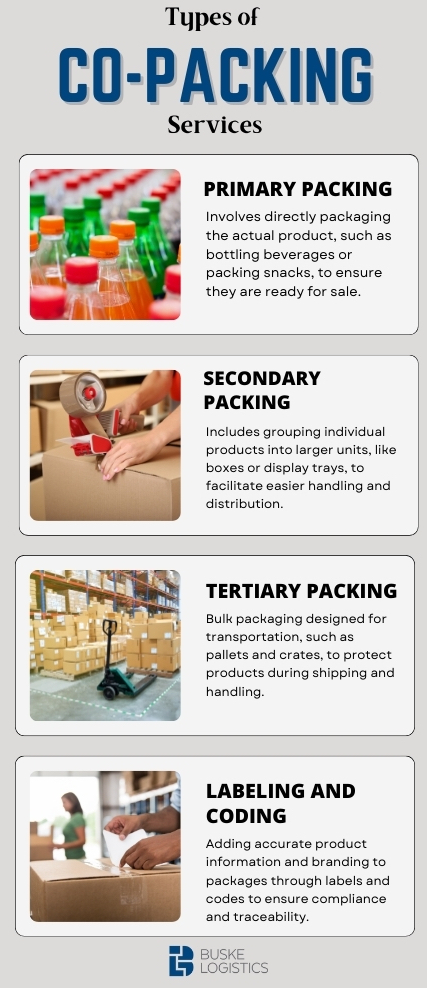
Co-packing for primary packaging is any handling of the actual product such as a liquid or food.
Co-packing for secondary packaging can be thought of as any services reconfiguring the primary packaging for display, cosmetic appearance, or final point of sale.
Tertiary packing can be considered as packaging to support movement of the product in bulk during shipping
Labeling and encoding are any of the stickers you seen on packaging for compliance or tracking.
The best co-packing service providers tailor solutions to your specific needs. Whether you need assembly, labeling, or blending, top co-packing companies will have proven processes to deliver consistent results.
Below are some of the services you can expect when you partner with top co-packing providers:
Co-packing is one of Buske’s value-added services, which includes managing manufacturing processes and assembly lines. Buske's expertise covers many Fortune 100 company partners, including PepsiCo, Coca-Cola, and Molson Coors.
Buske’s co-packing solutions also include efficiently coordinating production plans, ensuring its partners comply with regulations, and meeting forecast schedules.
Choosing the right co-packing partner can make or break your product launch, operational efficiency, and brand reputation. Whether you’re scaling up or entering new markets, here are the essential criteria to evaluate when selecting a co-packing company:
Ensure the co-packer has deep knowledge of your specific product category—this can streamline onboarding and reduce costly mistakes.
A credible co-packing provider should be fully compliant with industry regulations to protect your brand and meet legal standards.
Batch size flexibility is key—especially for startups or brands launching new SKUs.
Strong logistics integration can reduce time-to-market and streamline your operations.
Fast, reliable fulfillment is critical—especially during peak seasons or promotional surges.
Tech-enabled co-packing capabilities can offer better control, traceability, and communication.
Selecting a co-packing company isn’t just about cost—it’s about capability, compliance, and consistency. Prioritize partners that align with your industry, scale, and operational goals to build a supply chain that supports long-term growth.
Before signing an agreement, always compare co-packing companies carefully. Evaluate co-packing partners by assessing their certifications, capacity, and flexibility to adapt to your requirements.
Based on our experience and the questions asked, here are the key factors to consider:
Once you have a shortlist of co-packing companies, prepare questions to help you compare co-packing companies effectively. Here are a few questions to ask:
Apart from sharing resources, here are 3 key strategies to execute a co-packing strategy in logistics:
To appreciate the value of co-packing, here are some ways on how it can benefit companies:
3PLs share their resources, technology, and expertise with co-packing partners. Combined with joint planning and real-time communication, companies can quickly make decisions and well-coordinated actions. This results in fewer delays in the flow of goods within the supply chain.
Additionally, this allows for greater flexibility in logistics operations. For instance, Buske Logistics helps clients like Anheuser-Busch and Molson Coors remain agile with co-packing solutions. With co-packing solutions, companies can quickly adapt to changes in demand, market conditions, or unforeseen disruptions, ensuring seamless and efficient logistics.
Shared resources and expertise are vital elements of co-packing. A strategic co-packing partnership frees companies from making huge (and permanent) investments in machinery.
With a reliable 3PL provider like Buske, co-packing can yield substantial cost savings without compromising supply chain management.
An excellent copacking strategy gives businesses and 3PLs a more holistic view of the supply chain. Transparency in sharing information and joint problem-solving allows partners to identify and mitigate risks proactively. Ultimately, this approach reduces the likelihood of disruptions in the supply chain operation.
This is backed by 2021 research, which noted that collaboration within supply chains can mitigate supply and demand uncertainties. It could also help reduce costs while improving profits for manufacturers.
Enhancing overall customer satisfaction is one of the ultimate goals in partnering with a 3PL.
With the collaborative nature of co-packing, businesses can expect real-time updates and effective communication from their 3PL provider. This also allows companies to focus more on meeting customer needs and ensuring high service standards.
The combined benefits of efficiency, cost savings, and improved service quality enable companies to outperform competitors. By adopting co-packing in logistics, businesses can gain a significant competitive advantage to enhance brand reputation and customer loyalty.
Here's our free “Co-Packer Evaluation Checklist” to compare vendors side-by-side.

A co-packer, or contract packaging company, helps businesses outsource packaging, labeling, assembly, kitting, and sometimes fulfillment operations. Co-packing companies take products that are manufactured or sourced elsewhere and prepare them for retail, wholesale, or direct-to-consumer distribution. By partnering with a co-packer, businesses can reduce operational costs, increase efficiency, improve packaging consistency, and focus more resources on product development, sales, and business growth.
When evaluating co-packing companies, consider their industry experience, certifications, quality control processes, technology capabilities, and the range of co-packing services they offer. The best co-packing partners should demonstrate expertise in your product category, provide transparent pricing, maintain regulatory compliance, and offer scalable solutions that can support future growth. It's also important to assess their production capacity, turnaround times, inventory management capabilities, and ability to handle custom packaging requirements.
The best co-packing service providers help businesses stay competitive by improving operational efficiency, reducing labor costs, and accelerating time-to-market. Through advanced packaging equipment, streamlined workflows, and experienced production teams, co-packing companies can maintain consistent quality while increasing production speed. This allows businesses to scale more effectively, respond to market demand faster, and focus internal resources on strategic initiatives such as marketing, product innovation, and customer acquisition.
Experienced co-packing providers maintain product quality through strict quality assurance programs, standardized operating procedures, and ongoing compliance monitoring. Many co-packing companies utilize inspection checkpoints, barcode verification systems, batch tracking, and documented quality control processes to ensure products are packaged accurately and safely. Depending on the industry, they may also maintain certifications and follow regulatory requirements that help ensure compliance with food safety, consumer goods, healthcare, or retail standards.
A wide variety of industries benefit from co-packing services, including food and beverage, consumer packaged goods (CPG), health and wellness, beauty and personal care, retail, eCommerce, household products, and promotional marketing companies. Businesses in these industries often rely on co-packing companies for services such as product assembly, labeling, kitting, bundling, repackaging, subscription box preparation, and retail-ready packaging to improve efficiency and support growth.
Before selecting a co-packing partner, request client references, review case studies, assess industry experience, and evaluate their operational capabilities. Ask about production capacity, quality control procedures, technology platforms, compliance certifications, turnaround times, and scalability. Comparing multiple co-packing companies based on service offerings, reliability, communication, and long-term growth potential will help you identify the best partner for your packaging, fulfillment, and supply chain requirements.
Partnering with one of the top co-packing companies can give your brand a competitive edge. Contact Buske today to learn more about our co-packing services and discover why we’re among the best co-packing service providers in the industry.
New to co-packing? Read our ultimate guide to co-packing to understand the basics before you evaluate co-packing companies.


